 Mechanical Sealing Challenges in High-Density Server Cabinets
In hyperscale data centers, enterprise server architectures, and telecommunications equipment shelters, high-speed switching equipment generates intense electromagnetic fields across gigahertz bandwidths. As server chassis cram faster processors and switch silicon into 1U and 2U enclosures, electromagnetic interference (EMI) containment becomes critical. Enclosure doors, hot-swap drive bays, and removable side panels present massive mechanical seams where RF energy can easily escape. For data center enclosure designers selecting EMI gaskets, two shielding technologies dominate: Fabric-Over-Foam (FOF) profiles and Beryllium Copper (BeCu) metal fingerstock. Choosing the right profile requires navigating complex engineering trade-offs between mechanical closure force, cycling durability, shielding attenuation, and assembly cost.
A mismatched gasket can cause severe operational headaches. A gasket with excessive closure force can bow thin sheet metal doors, creating gaps that fail FCC emissions standards, while a fragile gasket can shred after a few server maintenance cycles. Analyzing the structural mechanics of both technologies reveals the optimal choice for modern enterprise enclosures.
Fabric-Over-Foam: Ultra-Low Compression Force for Sheet Metal Doors
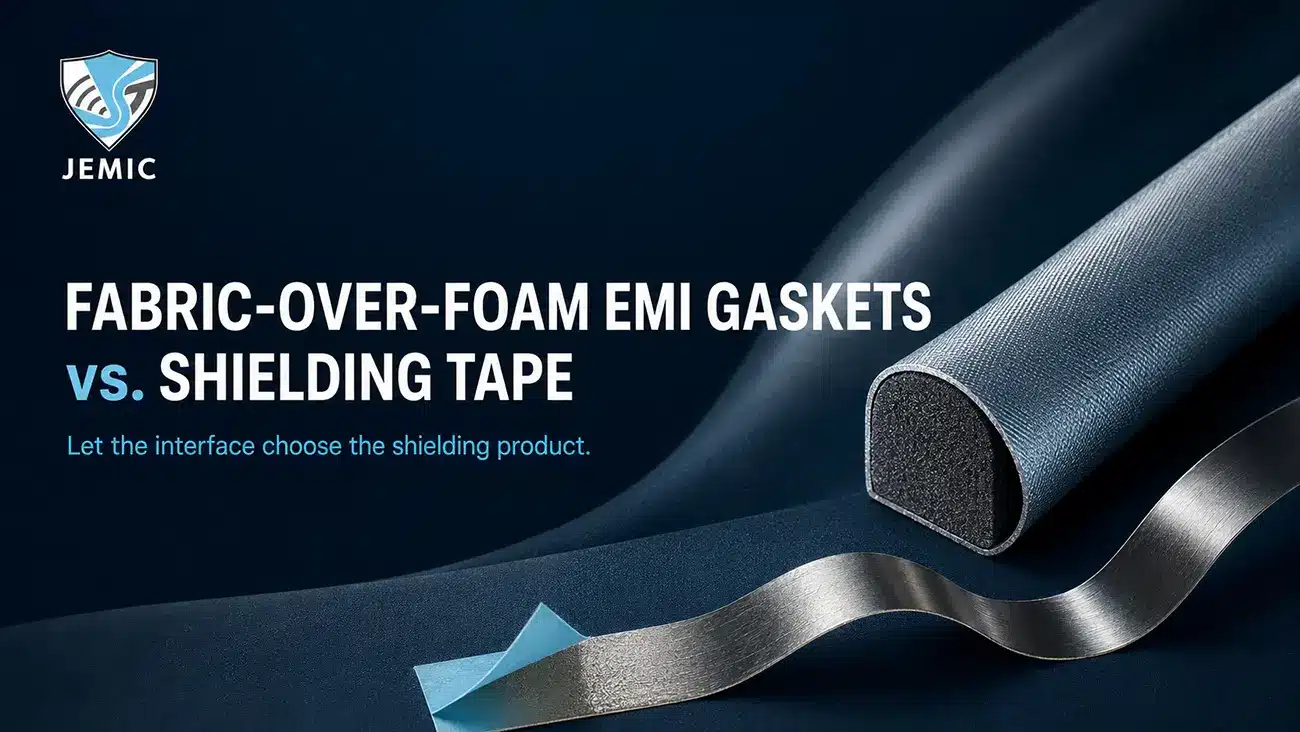
Fabric-Over-Foam gaskets are constructed by wrapping a highly conductive, metallized ripstop fabric around a resilient open-cell polyurethane or closed-cell silicone foam core. The exterior fabric is plated with continuous micro-layers of copper for superior conductivity and nickel for oxidation protection.
- Ultra-Low Closure Force (<1 lb/linear inch): Because the inner polyurethane foam core is exceptionally compliant, FOF gaskets compress easily under light latching pressure. This low force prevents bowing or warping in lightweight, stamped sheet metal cabinet doors.
- Wide Deflection Operating Range (20% to 50%): FOF profiles absorb significant dimensional tolerance variations, maintaining consistent electrical contact across tall, seven-foot server rack frames that may have slight manufacturing warpage.
- Broadband RF Attenuation: High-conductivity metallized fabrics provide outstanding electric and plane-wave shielding attenuation exceeding 90 to 105 dB from 100 MHz through 10 GHz.
- Integrated Dust and Particulate Barrier: The continuous outer fabric profile acts as an effective air baffle and dust seal, helping maintain clean cooling airflow within forced-air server cabinets.
Beryllium Copper Fingerstock: Mechanical Spring Memory and High-Cycle Wiping
Beryllium Copper (BeCu) fingerstock gaskets are precision-stamped from a high-performance copper-beryllium spring alloy that is heat-treated to achieve exceptional tensile strength and mechanical spring memory. These spring fingers are engineered to deflect mechanically when compressed by an access door or sliding chassis panel.
The primary mechanical advantage of BeCu fingerstock is its inherent wiping action. As a server door closes or a blade server slides into its slot, the spring fingers wipe across the mating metal flange, cutting through superficial surface oxidation and non-conductive films. Furthermore, BeCu possesses virtually infinite fatigue life, withstanding tens of thousands of opening and closing cycles without suffering compression set or loss of spring force.
However, fingerstock requires substantially higher closure forces than foam. When installed along the full height of a tall server cabinet door, the cumulative compression force can reach hundreds of pounds, requiring heavy-duty multi-point mechanical latches to secure the door completely.
Comparing Fabric-Over-Foam and BeCu Fingerstock Profiles
| Engineering Dimension | Fabric-Over-Foam (FOF) | Beryllium Copper (BeCu) Fingerstock |
| Internal Core Material | Open-cell polyurethane or silicone foam | Stamped, heat-treated spring alloy metal |
| Required Closure Force | Very low (0.5 to 1.5 lbs / linear inch) | High (3.0 to 10.0 lbs / linear inch) |
| Optimal Compression Range | 20% to 50% deflection | 25% to 75% finger deflection |
| Cycle Life Durability | Good (5,000 to 10,000 compression cycles) | Exceptional (50,000+ sliding/wiping cycles) |
| Mechanical Wiping Action | Low wiping; relies on flat surface contact | High wiping; cuts through surface oxidation |
| Plane Wave Shielding (1-10 GHz) | 90 to 105 dB attenuation | 95 to 110 dB attenuation |
| Environmental Sealing | Excellent dust / airflow baffle | None; open slots between fingers allow airflow |
| Installed Cost Profile | Highly economical; lower per-foot cost | Higher cost due to raw alloy and stamping |
Attachment Mechanisms and Galvanic Metallurgy
Gasket longevity is closely tied to the attachment method and the cabinet chassis metallurgy. For FOF profiles, non-conductive or conductive pressure-sensitive adhesive (PSA) tape is standard. Using high-tack conductive PSA provides a secondary grounding path through the tape itself, lowering overall transfer impedance across metal interfaces.
For BeCu fingerstock, attachment options include clip-on profiles for sheet metal edges, snap-in tracks, and riveted mounting bars designed for high-shear sliding panels. Galvanic compatibility is equally critical in server environments where humidity and airborne pollutants can generate corrosion cells. If bare copper fingers contact galvanized steel or bare aluminum, galvanic reactions will rapidly corrode the softer metal, creating high-resistance oxides that degrade RF shielding. To eliminate galvanic potential, plate BeCu fingerstock with tin, nickel, or silver to match the electrochemical potential of the server cabinet frame.
High-Frequency Cavity Harmonics and Acoustic Damping
An important secondary consideration in high-speed enterprise rack design is the dampening of internal cavity resonances. Server enclosures house dozens of high-RPM cooling fans alongside high-frequency switching power supplies. The mechanical compliance of FOF gaskets absorbs micro-vibrations, preventing acoustic rattling and chassis buzz under heavy server fan loads.
Additionally, the porous metallized ripstop fabric provides a minor degree of internal microwave cavity absorption, helping suppress standing wave reflections between adjacent chassis walls at frequencies above 6 GHz. While fingerstock excels at pure boundary conduction, FOF provides combined electrical shielding and mechanical acoustic dampening.
Application Matrix: Matching the Gasket to the Cabinet Subsystem
Rather than choosing one technology exclusively, modern enterprise server architectures frequently deploy both gasket types across different mechanical subsystems.
- Cabinet Front & Rear Perforated Doors: Fabric-Over-Foam is ideal here. Its ultra-low compression force allows lightweight doors to latch cleanly without bowing, while the foam profile seals perimeter seams against radiated high-frequency noise.
- Hot-Swap Blade Server Guide Rails: BeCu fingerstock is mandatory. The continuous wiping action and shear durability withstand thousands of blade insertions and removals without snagging or degrading.
- Removable Side Panels & EMI Baffles: FOF with conductive PSA provides an economical, high-shielding interface that absorbs frame tolerances while maintaining low transfer impedance across panel fasteners.
- Internal Inter-Compartment Baffles: Thin-profile FOF strips isolate power supply bays from sensitive motherboard processing zones, preventing switch-mode power harmonics from bleeding into digital traces.
Consultative Recommendations for Server Enclosure Engineering
Engineering reliable electromagnetic containment in high-density server architecture requires balancing mechanical rigidity with RF shielding physics. Specifying FOF for wide-tolerance hinged doors prevents latch binding, while deploying BeCu fingerstock on high-wear sliding drawers ensures decades of trouble-free connectivity.
By consulting with seasoned EMI shielding specialists early in the chassis design cycle, mechanical packaging teams can select the ideal cross-sectional profiles, compression ratios, and plating finishes. This proactive approach guarantees robust electromagnetic isolation, smooth user ergonomics, and seamless regulatory compliance across global data center deployments.